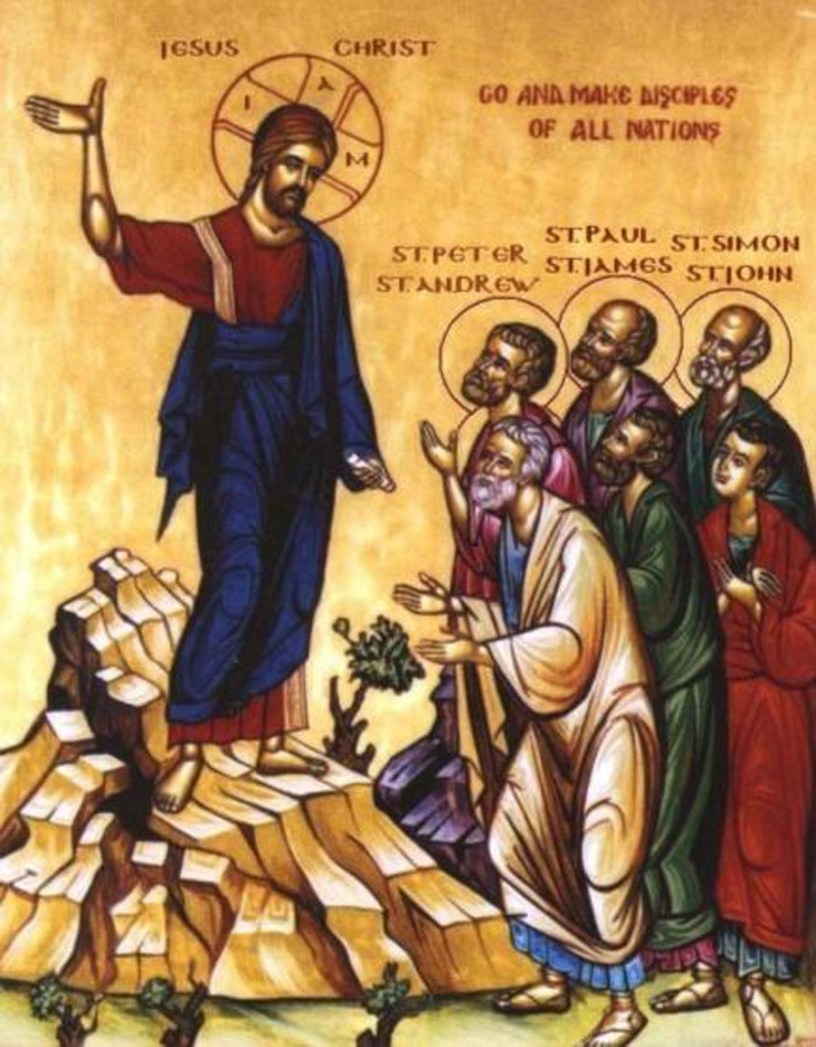
What did Jesus command in Matthew 28.19-20 (often called “the Great Commission”)?
There’s been some quibbling in the commentaries and blog world over two different ways to construe the passage. Specifically, how the opening participle relates to the main imperative. Here’s the Greek for reference, followed by the two main translations people argue for:
- πορευθέντες οὖν μαθητεύσατε πάντα τὰ ἔθνη…
- Go therefore and make disciples of all nations…
- Therefore, as you are going, make disciples of all nations…
The crux of the disagreement is about how to understand the participle.
Go, figure out the participle
Greek particles are notoriously tricky.
From the point of view of an English speaker, they often feel like slippery eels. Just as you think everything holds together, they slide away somewhere else. Any reasonable grammar of Greek will discuss how powerful and elusive participles are in Greek.
The venerable A. T. Robertson, probably the most influential English-writing grammarian dealing with the NT in the 20th century, wrote this about participles:
In itself, if must be distinctly noted, the participle does not express time, manner, cause, purpose, condition or concession. These ideas are not in the participle, but are merely suggested by the context, if at all, or occasionally by a particle like ἅμα, εὐθύς, καίπερ, νῦν, ὡς. There is no necessity for one to use the circumstantial participle. If he wishes a more precise note of time, cause, condition, purpose, etc., the various subordinate clauses (and the infinitive) are at his command, besides the co-ordinate clauses.
A. T. Robertson, A Grammar of the Greek New Testament in the Light of Historical Research, 3rd ed. (Nashville: Broadman Press, 1934), 1124.
In other words: participles bring with them an inherent amount of ambiguity that easily could have been avoided if that was what the writer wanted.
That’s just the problem here. How exactly does the participle relate to the main verb (“make disciples”) in the passage? In short, here are the points at issue:
- Should the participle be understood as almost a separate command
- Should it be understood as an accompanying action linked to the time frame of the main command “make disciples”
Thankfully, advances in grammatical study help us describe how the participle works with greater clarity.
Matthew’s pattern
Acknowledging the slippery nature of participles, I think Matthew behaves pretty consistently with this sort of participle + imperative set up we see here.
The pattern is pretty simple and follows the normal way that pre-verbal participles function. Here’s two other instances where a participle of a verb of motion (πορεύομαι and ἔρχομαι, to be precise) appears in a pre-verbal relation to an imperative. If you want to see all the rest of them, skip down to the bottom of the post.
See if you spot the pattern in how they are used:
| Mat 2.8 | |
| πορευθέντες ἐξετάσατε ἀκριβῶς περὶ τοῦ παιδίου | [go] search carefully for the child |
| Mat 17.27 | |
| πορευθεὶς εἰς θάλασσαν βάλε ἄγκιστρον | [go] to the sea cast the net |
Did you notice anything?
How about that in Matthew’s pattern, the action of the participle precedes the action of the imperative. I’ll say that a little differently:
Matthew uses the pre-verbal participle to communicate a background command that needs to be carried out before the person is in position to follow the main command.
The magi aren’t in position to search for the child (the main point of the command) until they have gone. The disciples aren’t in a position to cast the net until they have traveled to the sea. Get the idea? The participle gives what we might call a preparatory command that sets the stage so that you are now ready to carry out the main command.
With that thought in mind, why don’t you check through the rest of the related occurrences in Matthew down at the bottom of the post? I think you’ll see the pattern with ease.
Someday I’d love to check if this pattern holds more broadly throughout the NT and LXX and even other Koine Greek. But that day is not today. Interested in taking up the challenge? I’d love to hear your results if you do.
This is not surprising at all, given that pre-verbal participles traffic in background information as a general rule. In other words, pre-verbal participles that work with an imperative function pretty much like pre-verbal participles that work with an indicative main verb: they speak of a background action.
So, drawing it out into the sort of painful specificity that makes language cry out but interpreters feel like they have mastered the text, this means that Jesus commands the disciples to
- go
- and having followed the command to go, they are ready to deal with the “make disciples” portion.
At the level of grammar, this seems to be the point. We now turn to consider how this point interfaces with the storyline and theology of Matthew.
Why Jesus commands “go”
Why does Jesus phrase the command this way?
Here’s 2 good reasons:
- He’s the king on the mountain, and his Kingdom should spread
- To check the disciples’ impulse of veneration on a mountaintop
Jesus is King on the Mountain…and beyond
It is noteworthy that Matthew does not record an ascension into heaven.
He ends the narrative with Jesus as King on the mountain top giving a royal command. In spatial-visual terms, you might say that at that moment, Jesus’ kingdom is that mountain they are on.
His territory + his people = his kingdom
(see exhausting argument to this point by Dale C. Allison, Jr., Constructing Jesus: Memory, Imagination, and History (Grand Rapids: Baker Academic, 2010), 164–204.)
Since Jesus has an abiding interest in God’s kingdom coming to earth and since at that moment the kingdom is contracted spatially into that one mountain, the logical next thing to do is for the disciples to go somewhere else and make disciples.
Where Jesus is worshiped as king, there his kingdom is. Thus, “go!”
Not only is Jesus’ kingdom meant to spread, but Jesus’ command also speaks directly to the “stay here and venerate” impulse his disciples have already shown.
To check the “stay here and worship” response
Jesus commands the disciples to ‘go’ as the necessary first step of making disciples because they already have a poor track record when it comes to mountains, a glorified Christ, and what to do there.
At the transfiguration, Peter says to Jesus:
Lord, it is good that we are here. If you wish, I will make three tents here, one for you and one for Moses and one for Elijah (17.4 ESV)
In other words, let’s build a new tabernacle here because this is the place to be to worship!
Granted, it was a crazy experience and the response is entirely understandable, but Jesus is really clear that the point is not to turn this mountain into new shrine for his followers to tend. His kingdom is like a seed, compressed down into that tiny little space on the mountain, and it needs to blow up. That blowing up happens when they “go” and make disciples.
What Jesus commands in the Great Commission
Go is an important part of carrying out Jesus’ vision for the Kingdom of God spreading.
Wrapping it all up, there is both good language and literary-theological reason supporting the traditional translation of the text. In sequence of time, the disciples must carry out the command to “go” before they are ready to carry out the “make disciples.” While in many ways the debate is more a distinction without much difference, sometimes it is worth querying closely how the grammar and theology live together.
Phrased more interpretively, here’s my stab at capturing the gist of Jesus’ command:
“Go out to where I am not honored as King, and wherever you find that place, whoever you find there, make disciples so that I am honored as King there, too.”
Wherever you happen to be in life, there is certainly room for “going.” And you probably won’t have to go far to find places where Jesus isn’t honored as king.
Pre-verbal participle + imperative of verbs of motion in Gospel of Matthew: the rest of the data
Here are the other occurrences of a pre-verbal πορεύομαι and ἔρχομαι in Matthew. There are a few other instances of a pre-verbal participle connected to an imperative, which I think follow the same pattern, but we’ll just focus on these instances because the participles are in the same semantic domain.
5.24 καὶ τότε ἐλθὼν πρόσφερε τὸ δῶρόν σου
And then [come] offer your gift
9.12 πορευθέντες δὲ μάθετε τί ἐστιν· ἔλεος θέλω καὶ οὐ θυσίαν·
[go] and learn what it is “I desire mercy and not sacrifice”
9.18 ἀλλ’ ἐλθὼν ἐπίθες τὴν χεῖρά σου ἐπ’ αὐτήν, καὶ ζήσεται.
But [come] place your hand on her and she will live
10.7 πορευόμενοι δὲ κηρύσσετε λέγοντες ὅτι ἤγγικεν ἡ βασιλεία τῶν οὐρανῶν
[go] preach saying, the Kingdom of Heaven has drawn near
11.4 πορευθέντες ἀπαγγείλατε Ἰωάννῃ ἃ ἀκούετε καὶ βλέπετε·
[go] announce to John what you hear and see
28.7 καὶ ταχὺ πορευθεῖσαι εἴπατε τοῖς μαθηταῖς αὐτοῦ ὅτι ἠγέρθη ἀπὸ τῶν νεκρῶν
And immediately [go] speak to his disciples that he has risen form the dead
 NT Greek et al.